REVIEW · LOS ANGELES
Best of Downtown Los Angeles by Luxury E-Bike
Book on Viator →Operated by E Bike Tours LA · Bookable on Viator
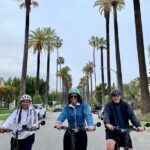
LA downtown becomes a story on wheels. This Luxury E-Bike ride strings together downtown icons and brand-new LA River crossings, starting in Atwater Village and ending back at the same bike bungalow. You’ll pedal through art spaces, big bridges, major markets, and classic historic landmarks without the stress of sitting in traffic.
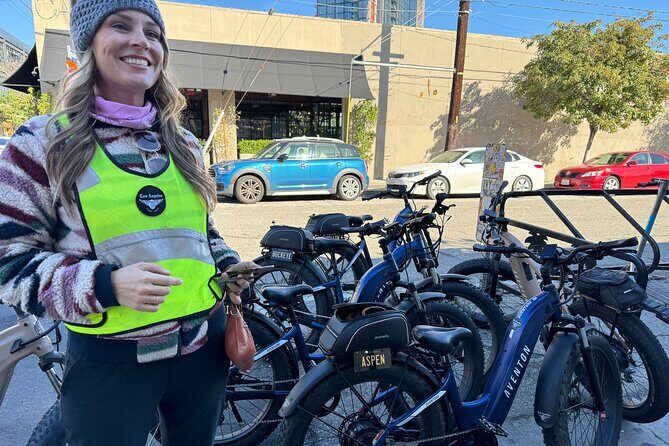
I like two things most. First, the setup is smart: you meet at a dedicated bike office, get fitted with safety gear, and are introduced to your e-bike (yes, they come with names). Second, the guide I learned from, Gavin, keeps the ride moving with stories and practical bike sense, plus a coffee break at Blue Bottle Coffee that actually hits the spot.
One consideration: lunch isn’t included, so you’ll want to bring cash or a card for food stops (street food and cafes are part of the fun, but it’s on you).
In This Review
- Key highlights on this Downtown LA luxury e-bike loop
- Atwater Village: where your downtown adventure actually starts
- How e-bikes keep 25 miles feeling doable
- The LA River magic: Red Car Pedestrian Bridge to fresh belvederes
- Glassell Park grit, Lincoln Heights spiral stairs, and the Brewery Art engine
- 6th Street Viaduct and the Ribbon of Light: park views under your wheels
- Coffee, markets, and bargain streets: Downtown LA without sitting still
- El Pueblo, Olvera Street, Avila Adobe: early LA in walkable snapshots
- Union Station and Chinatown: art deco grandeur up close
- Elysian Park and Frogtown: views and creative momentum to close
- Price, time, and who should book this luxury e-bike tour
- Should you book this Downtown LA luxury e-bike tour?
- FAQ
- What’s the meeting point for this tour?
- How long is the experience?
- How much does it cost?
- What language is the tour offered in?
- What’s included with the ticket?
- Is lunch included?
- How many people are on the tour?
- What fitness level do I need?
- Is there a mobile ticket?
- What’s the cancellation window?
Key highlights on this Downtown LA luxury e-bike loop
- Atwater Village start point in a walkable neighborhood built around cafes and artisanal shops
- LA River crossings like the Red Car Pedestrian Bridge and newer bike-only spans with viewing platforms
- Brewery Arts Complex + Stronghold Climbing Gym in an old industrial artist community
- 6th Street Viaduct helix ramp and Ribbon of Light arches plus a park underneath
- Downtown cultural stops from El Pueblo and Olvera Street to Union Station and Chinatown
Atwater Village: where your downtown adventure actually starts
Most “downtown tours” start at some anonymous hotel curb. This one starts somewhere you can warm up first: E Bike Tours Los Angeles in Atwater Village, at 3306 Glendale Blvd #2. You walk in, meet your local guide, and get your bearings without needing to decode a parking lot maze.
Atwater Village is also a good choice for the first part of the day. It’s easy to stroll around before you ride, and it sets a calmer tone before you mix into downtown traffic zones later. If you’re the kind of traveler who likes the day to feel like a route, not a checklist, you’ll appreciate the neighborhood-to-neighborhood flow.
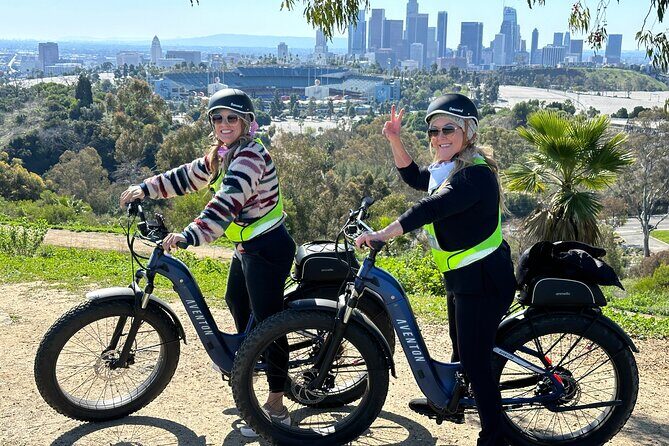
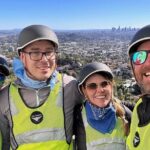
You’ll also get fitted with safety gear and introduced to the e-bike you’ll ride. A small detail, but it matters: all the bikes have names. It sounds playful, and it is, but it also helps you remember what you’re riding and how it works.
You can also read our reviews of more cycling tours in Los Angeles
How e-bikes keep 25 miles feeling doable
The whole pitch of an e-bike tour is less effort and more time seeing. Here, that translates to a route that covers a lot of downtown ground in one afternoon without turning into a leg-day punishment.
One review mentioned about 25 miles without much effort, which lines up with why e-bikes work so well for Los Angeles: you can cover distances that would be exhausting on a regular bike, while still keeping the street-level access you miss in bus tours. You’re also moving under your own power, which changes how you experience the city.
Small group size is part of the “luxury” feel too. The tour caps at 6 travelers. That usually means your guide can keep an eye on pacing and spacing and help you feel comfortable on the transitions, like switching from flat bike-friendly stretches to busier connectors.
Also, you’re not going to be hungry the instant you ride starts. Included snacks and bottled water show up early enough to keep energy up, especially before you hit the first set of river and bridge views.
The LA River magic: Red Car Pedestrian Bridge to fresh belvederes
This tour gives you two separate kinds of LA River wow: the old-school story bridge and the newer bike-and-ped bridges that feel built for today.
You start by rolling through quiet residential streets and entering the LA River corridor at the car-free Red Car Pedestrian Bridge. The name is a nod to the legendary Red Car Rail Trolleys that once rumbled over the same spot more than 60 years ago. It’s a fun bit of context while you ride, because you’re literally moving through a piece of transportation history that’s now reimagined for people on foot and bikes.
Right there, you also learn why the LA River mattered so much for the city’s existence. In an arid region, the river was lifeblood. Without it, Los Angeles as you know it wouldn’t have developed the same way.
Then you’ll be standing near the Hyperion Bridge, with a replica that also exists at Disneyland. And yes, there are neighborhood tie-ins you might not expect to hear while biking: Walt Disney lived about five minutes away in Los Feliz where he created Mickey Mouse in his aunt and uncle’s garage, later had his first studio in Silver Lake, and was a regular at the Tam O’Shanter (Table 31) in Atwater Village. Even if you’re not a Disney superfan, this kind of local geography makes the ride feel personal.
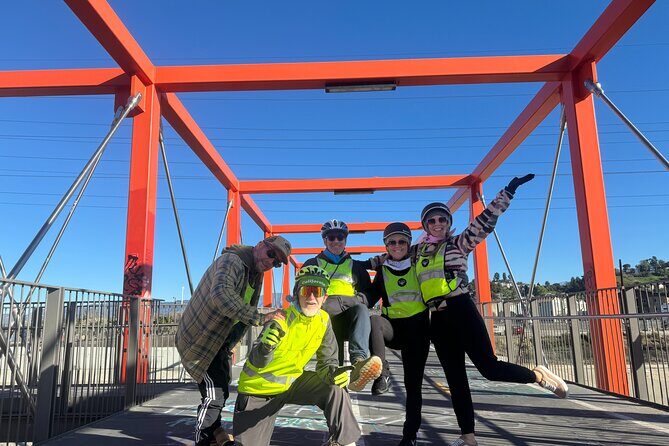
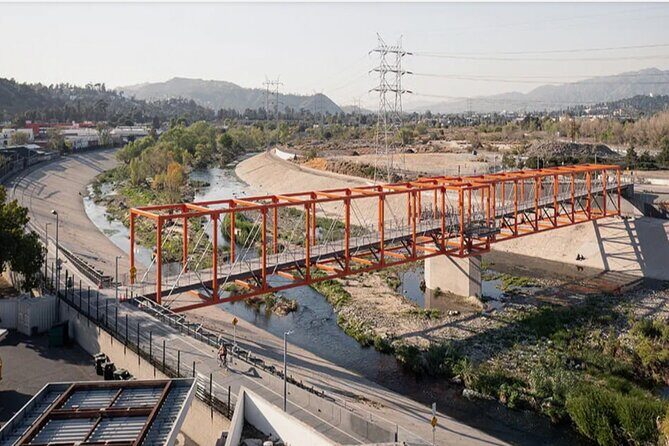
Later you hit a very different bridge experience: the new bright orange open-frame bike-walk bridge in the Elysian Valley area. It’s about 400 feet long and 20 feet wide, and it features two viewing platforms called belvederes, with expansive north and south views. These platforms are designed for pedestrians and bicyclists, so you’re not squeezed past cars, and you can actually pause to look around.
It also ties into a bigger plan. This crossing is part of the Los Angeles River Revitalization Master Plan, connecting the Elysian Valley and Cypress Park neighborhoods. The route hints at what’s next too: a future connection to the Taylor Yard G2 River Park on the 42-acre G2 parcel.
Why this matters for you: you’re not just moving through pretty places. You’re seeing how the city is choosing to re-balance access along the river, and you’re doing it with your legs and eyes, not through a car window.
Glassell Park grit, Lincoln Heights spiral stairs, and the Brewery Art engine
Between the river crossings and the downtown core, the tour switches gears into artsy, industrial, and slightly gritty Los Angeles.
In Glassell Park, you weave through back alleys and even pass through traffic tunnels. The tone here isn’t polished postcard. It feels more like the city you actually live in, with a pop-up flea market vibe popping in and out near the route. The stop is short, so you’re mainly getting the sense of how the neighborhood flows and what kind of texture LA has beyond its big landmarks.
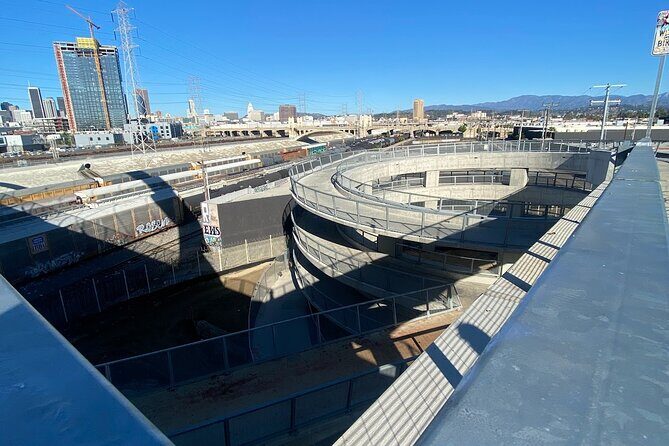
Then Lincoln Heights brings a mechanical wow factor: a spiral staircase over the 5 freeway. Even if you’ve seen staircases before, the first spiral element in the ride gives you a real sense of vertical movement without doing a full-on hike. After that, you’ll skirt the edges of Dogtown toward the Brewery District. It’s an LA shorthand route that helps you connect street-level names to actual places.
The Brewery Arts Complex is where the day starts feeling like an art map. The complex, also called the Brewery Art Colony, is described as the largest live-and-work artists colony in the world. It sits on a 16-acre compound across 21 former warehouses, with a former Edison power plant chimney dating to 1903. The mix is specific: studios, living lofts, restaurants, galleries, and a whole ecosystem of creative work.
There’s also a realistic note built in. More than 100 studios are open to the public during the twice-yearly Brewery Art Walk, so if your visit doesn’t line up with that schedule, you still get the atmosphere and the architecture, even if access to every studio may vary.
Inside that same complex is the Stronghold Climbing Gym. It’s located in the 23-acre Brewery Artist Lofts area and is housed in an old Pabst Brewing facility and the older California Edison Los Angeles Steam Power Plant. If you like repurposed buildings, this stop hits two notes: real industrial bones, and an active community space built into them.
6th Street Viaduct and the Ribbon of Light: park views under your wheels
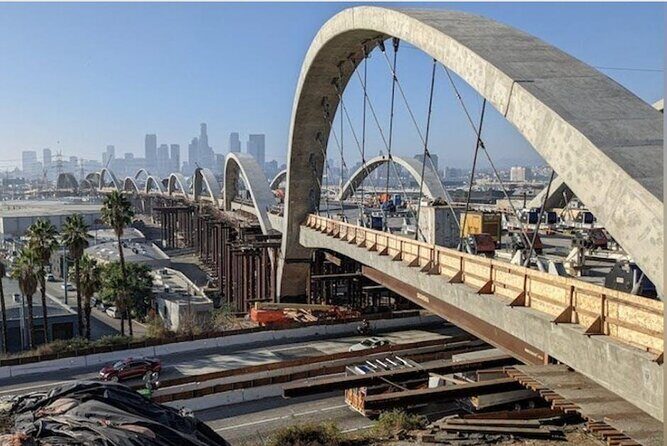
This is one of the most photogenic engineering moments on the route. The 6th Street Viaduct is a tiered arch bridge, and it’s referred to as the Ribbon of Light. The design pays homage to an earlier 1932 bridge with iconic arches that showed up in films, TV, music videos, and commercials.
The modern version uses 10 pairs of sculptural arches. The tallest pairs are placed adjacent to and framing the LA River where the original arches stood, and another taller pair spans US101 as a kind of gateway on the east.
Now for the part you’ll feel in your body: you access the bridge by riding up a monumental helical bike ramp. It’s the kind of movement that makes an e-bike feel extra fun, because you get the climb experience without feeling crushed by it.
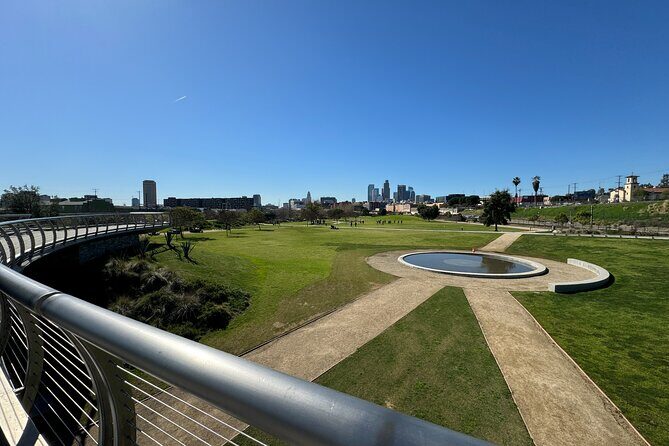
Underneath, there’s a 12-acre public park that ties the bridge experience to everyday use: recreational fields, restrooms, a cafe, and access to the LA River. Public art and an arts plaza are part of what sits under this big structure. So even if you just take a quick look during your short stop, you’ll see that the bridge isn’t just transportation—it’s now a whole public space.
Practical tip for your comfort: keep an eye on your footing and bike spacing on the ramp. Even on an e-bike, this is the kind of section where you’ll want to ride calmly and let the guide manage the group flow.
You can also read our reviews of more tours and experiences in Los Angeles

Coffee, markets, and bargain streets: Downtown LA without sitting still
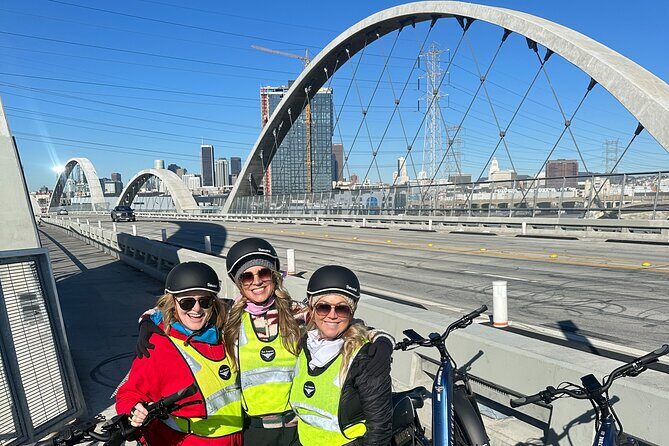
After the bridge moment, you get to reset with a coffee break. The tour stops at Blue Bottle Coffee on Mateo Street for a breather. It’s a simple pause, but it’s well timed: you’ve had engineering views, tunnels, and stair elements, and now you can take a few minutes to drink something warm or iced, refuel, and keep your energy steady.
Next comes a big downtown shift at The Row DTLA, where Fashion District, Skid Row, and the Arts District overlap. The Row is a mixed-use development with 100 retail stores and restaurants and 1.3 million square feet of commercial workspace across more than 30 acres. One reason it’s worth a stop for you is the built-in sense of routine: the 7th Street Produce Market opened in 1917 and sits inside this area, and every Sunday it turns into Smorgasburg, a free food market.
Then you roll into the Piñata District, and this is where the route leans into food culture. There’s a lunch stop with options like pupusas and tacos. You may also get a chance to try fermented Mexican beverages such as tepache (made from pineapple peel and rind) or pulque (from agave). Even if you don’t order everything, just being in the flow of a neighborhood food stop is a big part of why this tour works better than a museum-only day.
The Fashion District stop and Santee Alley stop are both about shopping energy, with different flavors. The Fashion District is the West Coast hub of the apparel industry. Santee Alley is the bargain-hunter corridor: an open-air corridor with 150+ retailers, where everything mixes together—electronics, food, knockoff fashion, and a nonstop sensory swirl of sunglasses, sneakers, shirts, suits, sequins, and soda and salsa vibes.
Short stop, fast impressions: that’s the trade. You won’t shop for hours, but you’ll understand the area’s style in a way you’d miss from a drive-by.
El Pueblo, Olvera Street, Avila Adobe: early LA in walkable snapshots
The ride finally brings you into the historic core with a cluster of landmark stops that fit together cleanly.
You start with the Federal Building, which includes two large mosaic murals: Celebration of our Homeland and Recognition of All Foreign Lands, each 26 feet tall. These murals are hard to miss, and the stop gives you a sense of how downtown layers civic imagery over time.
Then it’s El Pueblo de Los Angeles Historical Monument. This is the site where 44 settlers of Native American, African, and European heritage arrived from Mexico in 1781 and founded a village that grew into the city. The connection here is direct: you’re riding and then stepping into the geographic starting point for Los Angeles’ story.
Calle Olvera is next. This colorful Mexican marketplace has huarache sandals, embroidered blouses, woven blankets, and mariachi music that draws locals to dance in the plaza. It’s a lively contrast to the earlier markets and shopping streets, with a more pedestrian-centered vibe.
Right in this historic area is Avila Adobe, built in 1818 by Francisco Avila. It’s noted as the oldest standing residence in Los Angeles. The building sits in the paseo of historic Olvera Street, part of the Los Angeles Plaza Historic District within a California State Historic Park. It’s designated as a California Historical Landmark, and the whole district is listed on the National Register of Historic Places and recognized as a Los Angeles Historic-Cultural Monument.
Why I think these stops land well on an e-bike: you don’t have to commit to a long museum schedule. You get quick, high-impact moments and keep the momentum of the ride.
Union Station and Chinatown: art deco grandeur up close
After Olvera Street, you move through the bigger downtown civic core.
Los Angeles State Historic Park is a 32-acre state park in the heart of the LA River greenway. It sits around the midway point of an evolving 52-mile river greenway and is described as a catalyst for the River Revitalization Movement. It’s one of those stops that helps you connect the earlier bridge work to the bigger regional plan.
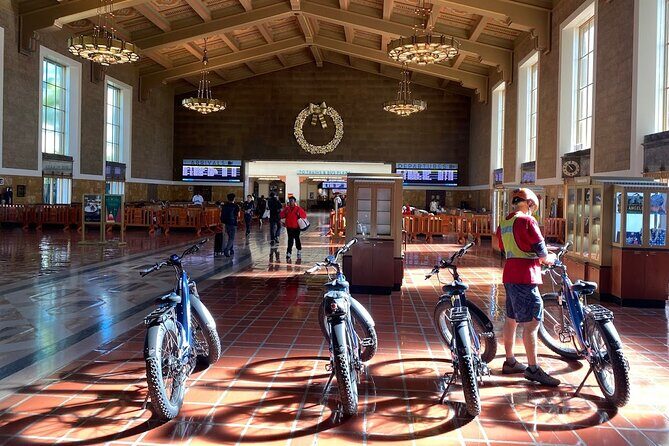
Union Station is the next major anchor. It’s widely regarded as the last of the great train stations, known for its decadent art deco design. It opened in May 1939 and is the largest passenger rail terminal in the Western United States. If you like movie locations, you’ve probably seen it on-screen too, with films and TV that include Blade Runner, Catch Me If You Can, Pearl Harbor, Dark Knight, Speed, and Euphoria.
Chinatown follows with a strong sense of identity. The Chinatown Gateway Monument features twin golden dragons welcoming visitors to the first Chinatown in the U.S. owned by Chinese residents. Along Broadway, shops and street vendors sell fresh produce, straw hats, toys, housewares, and more. You’ll see street art too, including the Dragon Chasing Pearl mural, a statue of martial arts star Bruce Lee, and art galleries around corners.
The tour also gives you a key timeline: the original Chinatown developed in the late 19th century, but it was demolished to make room for Union Station. The New Chinatown opened in 1938 and is still active, with restaurants, shops, art galleries, and a residential neighborhood.
One last note: Chinatown is fast on a bike. You won’t explore every block deeply, but you’ll understand the main sights and the neighborhood energy.
Elysian Park and Frogtown: views and creative momentum to close
Ending a downtown-focused day with an outlook helps it feel complete. You stop at Elysian Park, described as the city’s oldest park, founded in 1886. The views go across Dodger Stadium, the San Gabriel Mountains, Los Angeles, and out toward the Pacific Ocean.
Then you reach Elysian Valley, which is also known as Frogtown. This part of the route is framed as a hidden creative energy area with bike paths, art studios, and restaurants. It’s the kind of neighborhood finish that makes the day feel more local and less like you only toured famous scenery.
After that, you return via the LA River and back across the Red Car Bridge, so the day loops back to the same river corridor theme that started it. That structure makes it easier to remember later: bridges, art, downtown icons, and then the river ride home.
Price, time, and who should book this luxury e-bike tour
At $300 per person for a 4 to 5 hour ride, this isn’t a bargain deal. The value is in what’s included and what the e-bike unlocks.
Included: you get the bicycle, snacks, and bottled water. The tour also uses a mobile ticket and is offered in English. Most stops are marked as admission free, so you’re not paying entry fees repeatedly as you move through neighborhoods.
What you’re paying for is access plus pacing. You’re covering a lot of Los Angeles across major districts in one afternoon, including big-photo spots like Union Station, classic historic sites like Olvera Street and Avila Adobe, and the newer LA River crossings that are meant for bikes and pedestrians. On foot, some of those distances would be tough. In a car, you lose the street texture that makes the tour work.
This tour fits best if you want:
- a curated route across downtown and the river corridor
- a small group experience (maximum 6)
- moderate fitness for 4 to 5 hours of riding and short stop sections
- an easy way to see both old landmarks and newer LA River projects
If you’re the kind of traveler who wants long museum stops or hours in shops, you might feel rushed. Most stops are quick snapshots, which is the trade for doing so much in one ride.
Should you book this Downtown LA luxury e-bike tour?
If you want to experience Los Angeles like a route, not a checklist, I think it’s a strong choice. The combination of LA River bridge engineering, artsy industrial spaces at the Brewery complex, and major downtown landmarks like Union Station and Chinatown is a lot to pack into one day, and the e-bike makes it realistic.
Book it if you’ll enjoy short stop times, like moving between neighborhoods, and you’re willing to handle lunch on your own. Skip it if you need lots of downtime, dislike back-alley or tunnel sections, or would rather do slower, single-neighborhood exploration.
FAQ
What’s the meeting point for this tour?
The tour meets at E Bike Tours Los Angeles, 3306 Glendale Blvd #2, Los Angeles, CA 90039.
How long is the experience?
The duration is listed as approximately 4 to 5 hours.
How much does it cost?
The price is $300.00 per person.
What language is the tour offered in?
It’s offered in English.
What’s included with the ticket?
Included items are use of the bicycle, snacks, and bottled water.
Is lunch included?
No. Lunch is not included, and you can purchase food and drinks at stops along the way.
How many people are on the tour?
The maximum group size is 6 travelers.
What fitness level do I need?
The tour notes that travelers should have a moderate physical fitness level.
Is there a mobile ticket?
Yes, the tour includes a mobile ticket.
What’s the cancellation window?
Free cancellation is available up to 24 hours in advance for a full refund.